
Getting hurt at work can turn your life upside down in a matter of seconds. Medical bills start piling up, you may miss time at work, and the pressure of figuring out your legal options can feel overwhelming. One question many injured workers in Wisconsin ask is whether they can file a workers’ compensation claim and a personal injury claim at the same time.
The short answer is: sometimes, yes. Pemberton Personal Injury Law Firm has helped injured workers across Wisconsin understand when both options apply and how to protect their rights. If you were hurt on the job, Wisconsin work injury lawyers can help you determine which claims may be available to you.
What Does Workers’ Compensation Cover?
Workers’ compensation is a no-fault system. That means you do not need to prove that your employer did anything wrong to receive benefits. If you were injured while doing your job, you are generally entitled to compensation for medical treatment and a portion of your lost wages.
However, workers’ compensation has real limits. Pain and suffering, for example, is not covered. You also cannot sue your employer directly in most cases because workers’ compensation is considered the “exclusive remedy” against employers under Wisconsin law.
When Can You File Both Claims?
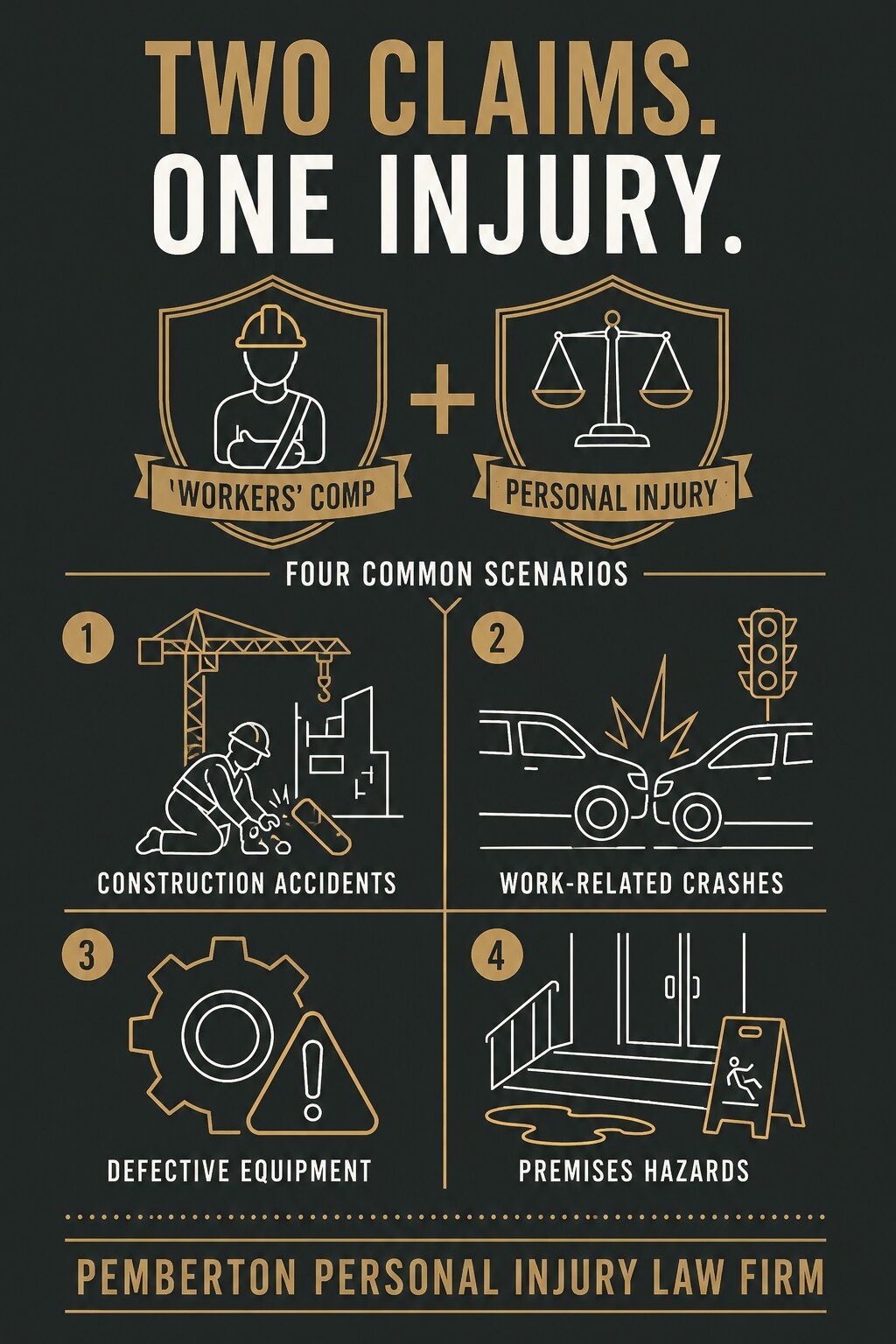
The key factor in filing both a workers’ compensation claim and a personal injury claim is whether a “third party” was responsible for your injury. A third party is someone outside the employer-employee relationship. Under Wisconsin Statute § 102.29, an injured worker may file both claims when a third party’s negligence caused or contributed to the injury.
Here are some common situations where both claims may apply:
- Construction site accidents: A subcontractor or equipment manufacturer may be liable if their negligence causes a job-site injury.
- Work-related car accidents: If you were driving for work and another driver caused the crash, that driver may be a third party.
- Defective equipment: If a faulty tool or machine injured you at work, the manufacturer could be held responsible.
- Premises hazards: If you were injured on someone else’s property while performing work duties, the property owner may share liability.
Both claims can run at the same time, and each one operates under different rules.
How Are the Two Claims Different?
Understanding how these claims differ is important. Workers’ compensation pays out regardless of fault, while a personal injury claim requires proving that another party was negligent. A personal injury claim can help you pursue compensation that workers’ comp simply does not offer, including pain and suffering, full lost wages, and long-term damages.
The Role of Liens in Your Settlement
One important factor to know is that your employer’s workers’ compensation insurance carrier may have a right to recover some of what it paid you if your personal injury claim succeeds. This is called a lien. It means that when you receive a personal injury settlement, part of that money may go back to the workers’ compensation insurer.
This does not mean you should avoid pursuing a personal injury claim. In most cases, the total amount you recover between both claims is higher than workers’ compensation alone. An attorney can help you understand how a lien might affect your outcome.
What About Deadlines for Filing?
Deadlines for each claim are different, and understanding them is important. For workers’ compensation claims in Wisconsin, injured workers generally have two years to report the injury to their employer, but the formal deadline to file a claim is typically six years from the date of injury for traumatic injuries, or twelve years for occupational disease claims under Wis. Stat. § 102.17(4).
For personal injury claims involving a third party, the statute of limitations is typically three years from the date of the accident. However, some important exceptions and nuances can affect the applicable deadline.
Do Construction Accidents Create Third-Party Claims?
Construction sites are one of the most common places where both claims come into play. Multiple contractors, subcontractors, and equipment suppliers are often on site at the same time. If you were hurt in a construction accident, and someone other than your employer contributed to the incident, you may have a valid third-party claim.
The same logic applies to work-related car accidents on Wisconsin roads. If another driver caused the crash while you were working, you may be able to pursue a personal injury claim in addition to your workers’ comp benefits.
Reach Out to Pemberton Personal Injury Law Firm Today
These situations can be legally complex. Workers’ compensation rules, third-party liability laws, and lien rights interact in ways that are easy to get wrong without guidance. Pemberton Personal Injury has over 80 years of combined experience representing injured people across Wisconsin, and we know the difference between what insurance companies offer and what our clients actually deserve. We have achieved a landmark jury verdict in a high-stakes personal injury case, and we are recognized by Super Lawyers for 14 consecutive years.
If you were hurt on the job and believe a third party may be responsible, do not wait to get answers. Reach out to Pemberton Personal Injury for a free case evaluation.